




ASAF critical findings: eight priority areas at risk
Australian Science, Australia’s Future: Science 2035 reveals dangerous gaps in workforce, infrastructure and coordination that will cripple Australia's ability to meet 2060 challenges.

The Academy’s report projects capability gaps in eight key science areas that will be most in demand by 2035: agricultural science, AI, biotechnology, climate science, data science, epidemiology, geoscience, and materials science.
The analysis found:
- We aren't training enough geoscientists, yet our economy rests heavily on resources, and critical minerals is a priority of the National Reconstruction Fund under ‘value-add in resources’.
- Jobs in artificial intelligence (AI) are expected to surge, yet only one in four Year 12 students is studying mathematics – the fundamental science discipline underpinning AI.
- We’re facing national shortages of materials scientists, and the workforce in process and resources engineering is also projected to decline.
- The current pipeline and study choices of students is not aligned with the needs of our future workforce, with declining STEM participation and teacher shortages a looming threat.
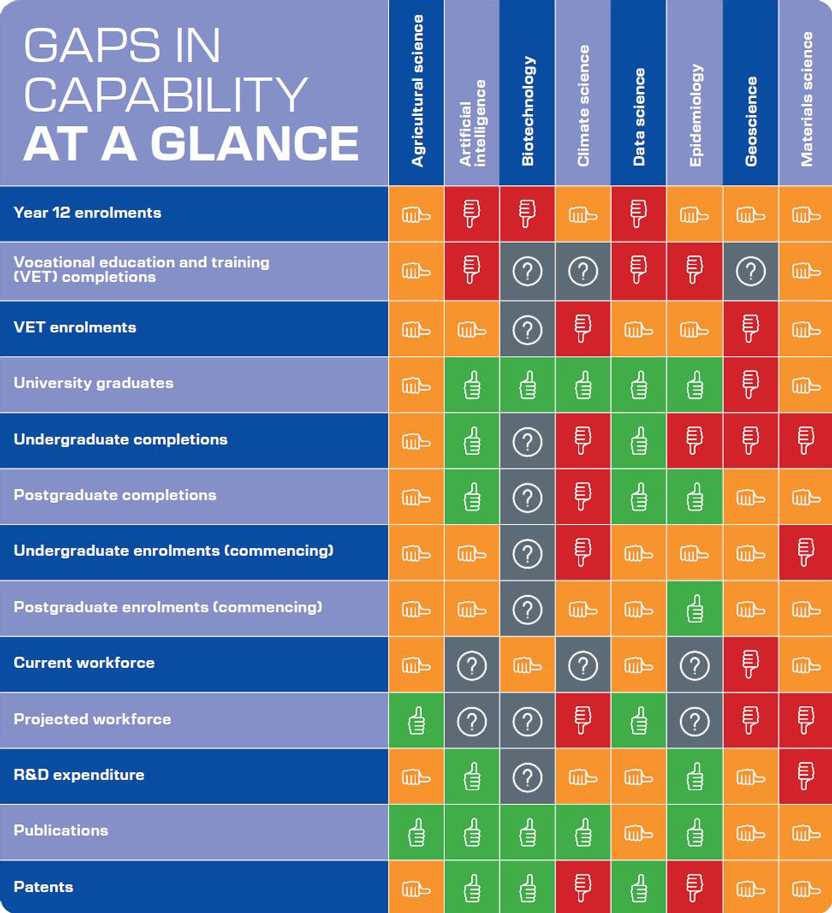
Rating scale for the graphic above:
- Green thumb: No trends decreasing. No gap or unlikely to have a gap in capability.
- Amber thumb: Some trends decreasing or no majority of increasing trends. Some gap or likely gap in capability.
- Red thumb: Most trends decreasing. Existing gap or certain gap in capability.
- Question mark: Insufficient data available.
This report provides critical, evidence-based, in-depth analyses that will inform science and policy leaders tasked with shaping the Australian science, education and immigration landscapes. In addition, it can act as a guide for philanthropists looking to make nation-building investment decisions.
See a detailed text description of this graphic, that aims to improve accessibility of the graphic for a broad audience.